
Five Prior Art Categories an AI Patent Expert Witness Examines
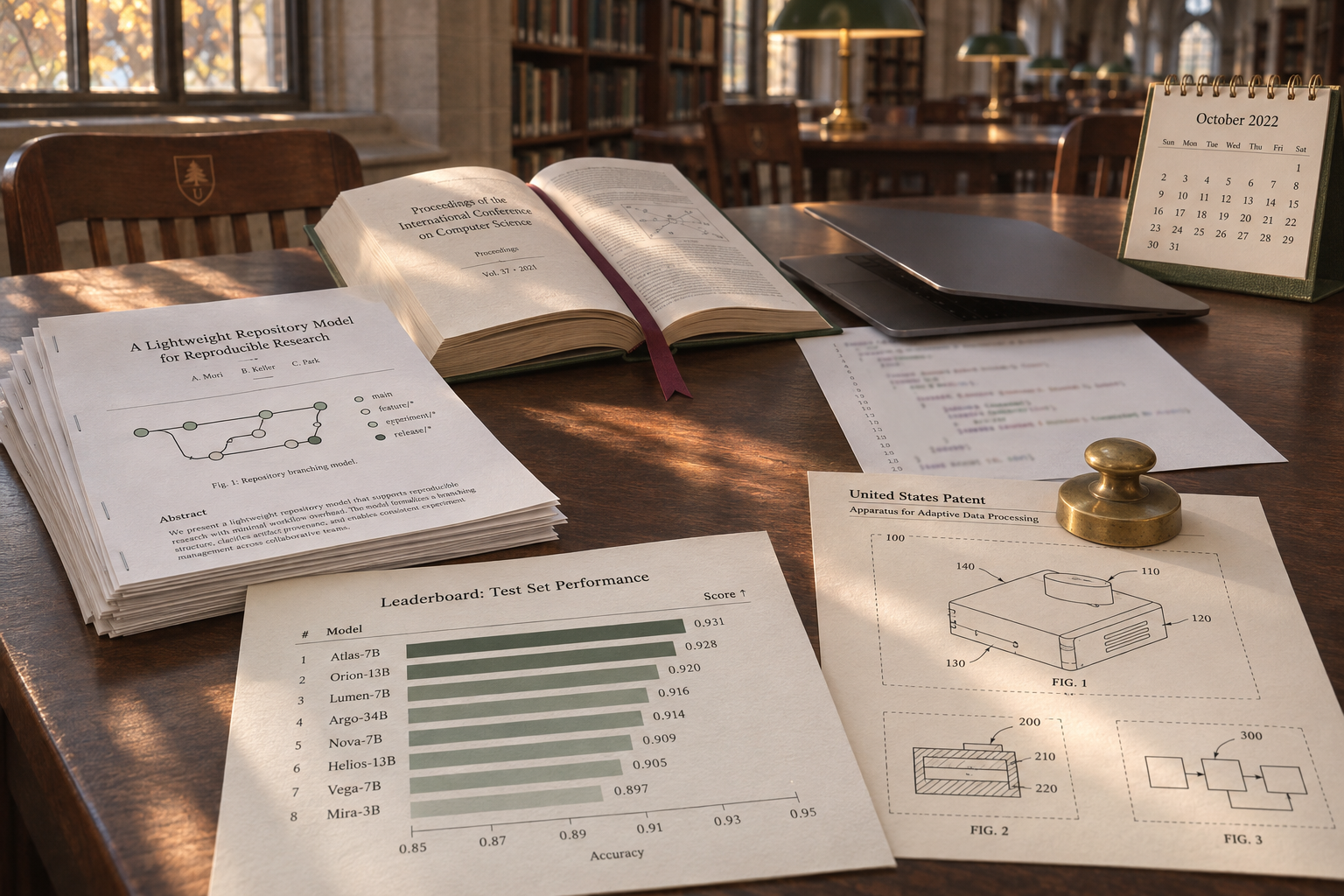
Where an AI Patent Expert Witness Looks for Prior Art Outside Patent Databases
For an AI patent expert witness, prior art for machine learning patents is frequently documented first in places a patent database never indexes: preprint servers, conference proceedings, source code repositories, and competition write-ups. A search limited to issued patents and published applications can therefore miss references that predate a challenged claim’s priority date, sometimes by years. The volume alone explains the gap. arXiv passed two million total submissions in January 2022, and NeurIPS 2023 received 12,343 full paper submissions, of which 3,218 were accepted. Over the same period, the USPTO Office of the Chief Economist reported that annual AI-related utility patent applications more than doubled, from about 30,000 in 2002 to more than 60,000 in 2018.The statutory frame is 35 U.S.C. 102, which lists claimed inventions that were “patented, described in a printed publication, or in public use, on sale, or otherwise available to the public” before the effective filing date. This post describes the categories of non-patent sources commonly examined in machine learning invalidity work, and the dating records associated with each, from the perspective of a software expert witness rather than a legal one. The five categories are preprints and proceedings, open-source releases, pre-deep-learning statistical learning literature, benchmarks and competitions, and standards and API specifications.Key Takeaways for Software Patent Attorneys
- Each category of non-patent source carries a distinct kind of date record: arXiv version timestamps, git commit and tag dates, package-index upload times, leaderboard entries, and standards-body upload records.
- Date records and accessibility records are separate questions. Practitioners typically assemble both, since a timestamp alone does not describe who could have located the reference.
- Older statistical learning literature may describe operations that later claims recite under different vocabulary, and the terminology mapping is presented against the claim construction at issue in the case.
- Petitions and contentions commonly preserve the reference at a specific version, the date record, the accessibility record, a retrieval log, and a technical reading tied to claim language.
Who This Article Is For
This article is written for software patent attorneys preparing invalidity contentions, inter partes review petitions, or responses to either, where the challenged claims recite machine learning or adaptive components. It will also be useful to IP litigation associates, patent agents conducting software patent prior art search work, in-house counsel evaluating AI patent invalidity exposure before a dispute matures, and counsel assessing why litigation may be brewing around generative AI.Preprint Servers and Conference Proceedings as Printed Publications
Which arXiv Version and Date Is Cited
arXiv, bioRxiv, and OpenReview records carry per-version submission timestamps. As the arXiv documentation on article versions explains, each submission receives v1, v2, and later version identifiers with separate dates, and the content of each version can differ substantially. A v3 posted after a priority date may describe an architecture that v1 did not. For that reason, practitioners identify the version actually relied on by its version number and date, and quote from that version rather than from the current listing.Dating a Conference Paper
Conference proceedings for NeurIPS, ICML, CVPR, and ICLR are associated with several candidate dates: the submission deadline, the camera-ready deadline, the posting of the proceedings, and the conference session itself. These can span many months, and proceedings are sometimes posted after the conference ends. Practitioners document which date is used and what record supports it.MPEP 2128 describes the public-accessibility inquiry for printed publications, including electronic publications. The Federal Circuit has addressed accessibility of online and conference materials in opinions including In re Klopfenstein, SRI International v. Internet Security Systems, Voter Verified v. Premier Election Solutions, and Blue Calypso v. Groupon. The PTAB Precedential Opinion Panel addressed the threshold showing at institution in Hulu v. Sound View Innovations.Evidence commonly assembled to support an arXiv preprint printed publication reference includes arXiv listing metadata, DOI registration records, proceedings indexes, captures from the Internet Archive Wayback Machine (the Federal Circuit considered Wayback Machine evidence in Valve Corp. v. Ironburg Inventions), and declarations from librarians or program chairs.A technical reading step follows the dating work. A preprint may describe an architecture in notation that differs from claim language, using equations, pseudocode, or diagrams where the claim uses functional phrases. The technical reading explains the correspondence between the reference and the claim language, element by element, under the construction at issue. How that correspondence bears on anticipation or obviousness is addressed by the tribunal under the applicable legal standard.Open-Source Repositories and Framework Releases: Dating With Commits, Tags, and Package Indexes
Framework code in TensorFlow, PyTorch, scikit-learn, and Keras is one of the sources examined for implementations of a training procedure, layer type, or optimization step that may predate a patent’s priority date. In open source software prior art work, the source file, its docstrings, and the accompanying release notes are each examined and separately dated, the same provenance discipline that litigation over AI-generated code requires. Whether they are treated as a single reference or as several is a question addressed in the petition or contention under the applicable standard.Four Timestamps in a Git Record
Git records provide several timestamps that do not always agree. The Git documentation on viewing commit history distinguishes the author date from the committer date. Tag creation dates and GitHub release publication dates are separate records again. Both the author date and the committer date are set by the local clock of the machine that created or rewrote the commit. A default rebase preserves the author date and resets the committer date, and either value can be set arbitrarily when history is rewritten. Records outside the repository, such as package-index upload times or archive captures, are examined alongside the repository dates for this reason.Package indexes such as PyPI, conda-forge, npm, and Maven Central record upload times for each released artifact and retain the artifact itself. This lets a reviewer compare the code that shipped on a given date against the current repository state, which matters when a function has been renamed or refactored since the release.What Shows a Repository Was Public
Public accessibility questions for repositories mirror those for publications. The records examined include whether the repository was public at the time, whether it was indexed or announced through mailing lists, release blog posts, or discussion threads, and whether a person of ordinary skill could have located it. The Federal Circuit considered an FTP directory in SRI v. Internet Security Systems, and practitioners analyzing repositories have drawn on that discussion.Software expert witnesses typically preserve this evidence by cloning the repository at a specified commit hash, recording the hashes of the relevant files, capturing the package-index pages, and documenting the retrieval date and method so another reviewer can repeat the retrieval.Pre-Deep-Learning Statistical Learning Literature and the Terminology-Mapping Work
Support vector machines, hidden Markov models, Bayesian networks, boosting, kernel methods, and expectation-maximization appear in literature from the 1980s through the 2000s, in work by Vapnik, Rabiner, Pearl, Freund and Schapire, Bishop, and Hastie and Tibshirani. That literature uses vocabulary that differs from current claim drafting, and whether an older description and a claim element refer to the same operation on the same kind of data is examined reference by reference against the construction at issue. Term pairs that recur in this work include:Examples of Vocabulary Drift
- “Feature extraction” in older texts and “representation learning” in recent claims
- “Regularization” or “weight decay” and later phrasing about penalizing model complexity
- “Latent variable” and “embedding”
- “Sequential decision process” and “policy”
- “Kernel trick” and “implicit feature map”
Benchmark Datasets, Model Zoos, and Competition Write-Ups That Describe Architectures Before a Priority Date
The ImageNet Large Scale Visual Recognition Challenge ran annually from 2010 through 2017, using a 1,000-category classification task drawn from a dataset of more than 14 million annotated images. Its challenge reports, together with Kaggle competition solution write-ups and challenge papers for PASCAL VOC, COCO, GLUE, and MLPerf, describe winning architectures, training schedules, augmentation, and ensembling, often months before any journal version appears.Model zoos such as the Caffe Model Zoo, TensorFlow Hub, the Hugging Face Hub, and torchvision.models distribute weights together with model cards, configuration files, and README documentation that specify layer structure and hyperparameters.Dating Records Specific to This Category
Dating records include challenge submission deadlines, leaderboard timestamps, forum post dates on Kaggle, and model-card commit histories. Each is a different kind of record, and practitioners document which one they rely on and why. Attorneys often ask whether a Kaggle forum post or competition write-up can be cited as a printed publication. Practitioners have cited such write-ups, and the accessibility record assembled for them resembles that for any web posting: archive captures, forum metadata, and evidence of how the post was reachable.A competition write-up can describe a procedure in prose and code snippets. Whether a reviewer can reproduce the described result is a separate question from whether the description was publicly accessible on a given date, and the two are documented separately. Dataset documentation papers themselves, such as the ImageNet CVPR 2009 paper, sometimes disclose preprocessing and labeling procedures that later claims recite.Standards Documents and API Specifications Where Adaptive or Learned Components Appear
Telecom and signal-processing standards, including 3GPP technical specifications, ITU-T recommendations, the IEEE 802 series, and ETSI documents, describe adaptive equalization, adaptive codebooks, channel estimation, echo cancellation, and voice activity detection. Practitioners have examined these disclosures against claims to adaptive or learned components.Standards bodies maintain contribution records with meeting dates and upload timestamps. The 3GPP document archive holds specifications and meeting Tdocs, and IETF Internet-Drafts carry similar records. The Federal Circuit addressed accessibility of distributed materials in related contexts in GoPro v. Contour IP and In re Lister, and PTAB panels have considered 3GPP document availability on a case-by-case basis.API specifications and SDK documentation, including CUDA, cuDNN, OpenCL, and ONNX operator sets, specify operations, data layouts, and quantization behavior with versioned release dates.How Grounds Are Organized
In petitions and contentions, a single-reference ground sets out each claim element from one document. A multi-reference ground sets out which elements come from which reference and articulates a reason to combine them. KSR v. Teleflex and the Graham factors are the authorities courts cite when evaluating an obviousness combination for machine learning claims, and the PTAB Consolidated Trial Practice Guide describes how grounds and supporting evidence are organized. The suitability of either type of ground depends on the references and the claims at issue. For context, USPTO PTAB trial statistics for FY2023 reported an institution rate of approximately 67 percent by petition.How an AI Patent Expert Witness Documents Prior Art for an Invalidity Contention or Petition
The common thread across the five categories is that each source carries its own kind of date record (version timestamp, commit hash, package upload time, leaderboard entry, Tdoc upload) and its own accessibility record (indexing, announcement, archive capture). PTAB petition prior art evidence for non-patent references is typically assembled from both, and the same documentation discipline applies in disputes over the legal implications of AI chatbots, where the model releases at issue carry their own date and accessibility records.Practitioners typically preserve the following for each reference:- The document or code at the specific version relied on
- The date record for that version
- The accessibility record showing how the reference could be located
- A retrieval log recording when and how it was obtained
- A technical reading connecting the reference to claim language under the construction at issue
Written by
Computer scientist with a Ph.D. in artificial intelligence. Launched Google TV globally, designed 3G wireless systems at Nortel, and has invested in AI and telecom startups as a venture capital principal. Former associate professor and testifying expert witness.
Related Insights
Sidespin Group President Istvan Jonyer, PhD joined host Derek Staahl on Generation AI, Arizona's Family's technology program, for a segment...
Demonstrative evidence format is a critical, yet often overlooked, strategic decision in software IP litigation. This post examines how a...
Discuss your Case
- info@sidespingroup.com
- (800) 510-6844
- Monday – Friday
- 8am – 6pm PT
- 11am – 9pm ET
Lead Expert

Computer scientist with a Ph.D. in artificial intelligence. Launched Google TV globally, designed 3G wireless systems at Nortel, and has invested in AI and telecom startups as a venture capital principal. Former associate professor and testifying expert witness.