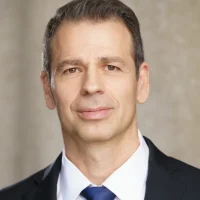
Istvan Jonyer, PhD Discusses Robotaxi Safety on Arizona's Family's "Generation AI"
Sidespin Group President Istvan Jonyer, PhD joined host Derek Staahl on Generation AI, Arizona’s Family’s technology program, for a segment on the rapid expansion of driverless robotaxi services and the unusual failures that come with it. Watch the segment.
The timing followed a busy stretch for the industry. Amazon’s Zoox began charging for rides in Las Vegas, Waymo went fully driverless in four additional cities, and Waymo’s fleet reached roughly five times the size it was a year earlier.
Why scale is the point
Jonyer, a computer scientist with a doctorate in artificial intelligence and a former Google executive, explained that expansion is not incidental to safety work. It is how developers find the scenarios nobody anticipated.
“Expansion is the way to encounter the unusual cases,” he said. With ten cars on the road, the rarest situations never come up. Across millions of miles, they do. “You do have to expand for the statistics to start working in your favor.”
Google built a mock town where engineers stage scenarios before vehicles reach public roads, he noted, but that approach has a built-in limit: “there are only so many things you can even imagine.”
Why rain is still hard
Asked about weather, Jonyer traced the difficulty to sensor physics. Waymo vehicles carry cameras, radar, and lidar. Lidar builds a three-dimensional model of the surroundings by emitting laser light and timing how long it takes to return. Rain scatters that light.
“It can come back from a raindrop as well, which is very close to the car,” he said, describing the resulting depth fuzziness. Cameras still read stop signs and recognize shapes, but as he put it, “if you’re robbed of your sense of three dimensionality, then it’s going to make it much harder to drive.”
He characterized it as a solvable engineering problem rather than a permanent constraint, and pointed to Tesla as the counterexample, a company betting that cameras plus enough computing power can rebuild the same picture without lidar.
The emergency scene gap
Jonyer also raised a question that currently has no standardized answer. If a driverless vehicle approaches an active crime scene, how does an officer tell it not to proceed? A human driver responds to a raised hand. There is no uniform command set every operator must honor, and no universal device an officer can activate. He suggested that either would close the gap, and that standardizing safety measurement is an area where government has a role.
Istvan Jonyer, PhD is President of Sidespin Group. He holds a doctorate in computer science with a specialization in artificial intelligence, led global device partnerships for Google TV, designed 3G wireless systems at Nortel Networks, and evaluated autonomous technologies as a venture investor.
For media inquiries or to discuss artificial intelligence and software matters, contact Sidespin Group.
Written by
Related Insights


Discuss your Case
- info@sidespingroup.com
- (800) 510-6844
- Monday – Friday
- 8am – 6pm PT
- 11am – 9pm ET
Lead Expert