
Demonstrative Evidence for Software IP: Static vs. Interactive Reviewed
Why the Choice of Demonstrative Format Can Win or Lose a Software IP Case
Engaging a qualified software expert witness early in case development is one of the most consequential strategic decisions a litigation team makes, yet demonstrative evidence format is frequently treated as a production afterthought rather than a core case development priority. Software and computer technology patents now account for roughly 60% of all patent applications filed at the USPTO, according to the USPTO Patent Technology Monitoring Team, and federal courts resolve over 3,500 patent cases annually, with software-implemented inventions representing the largest single technology category tracked by Lex Machina. That volume means litigators face mounting pressure to translate genuinely complex technical architectures, algorithmic processes, and source code behavior into narratives that lay jurors can evaluate with confidence.
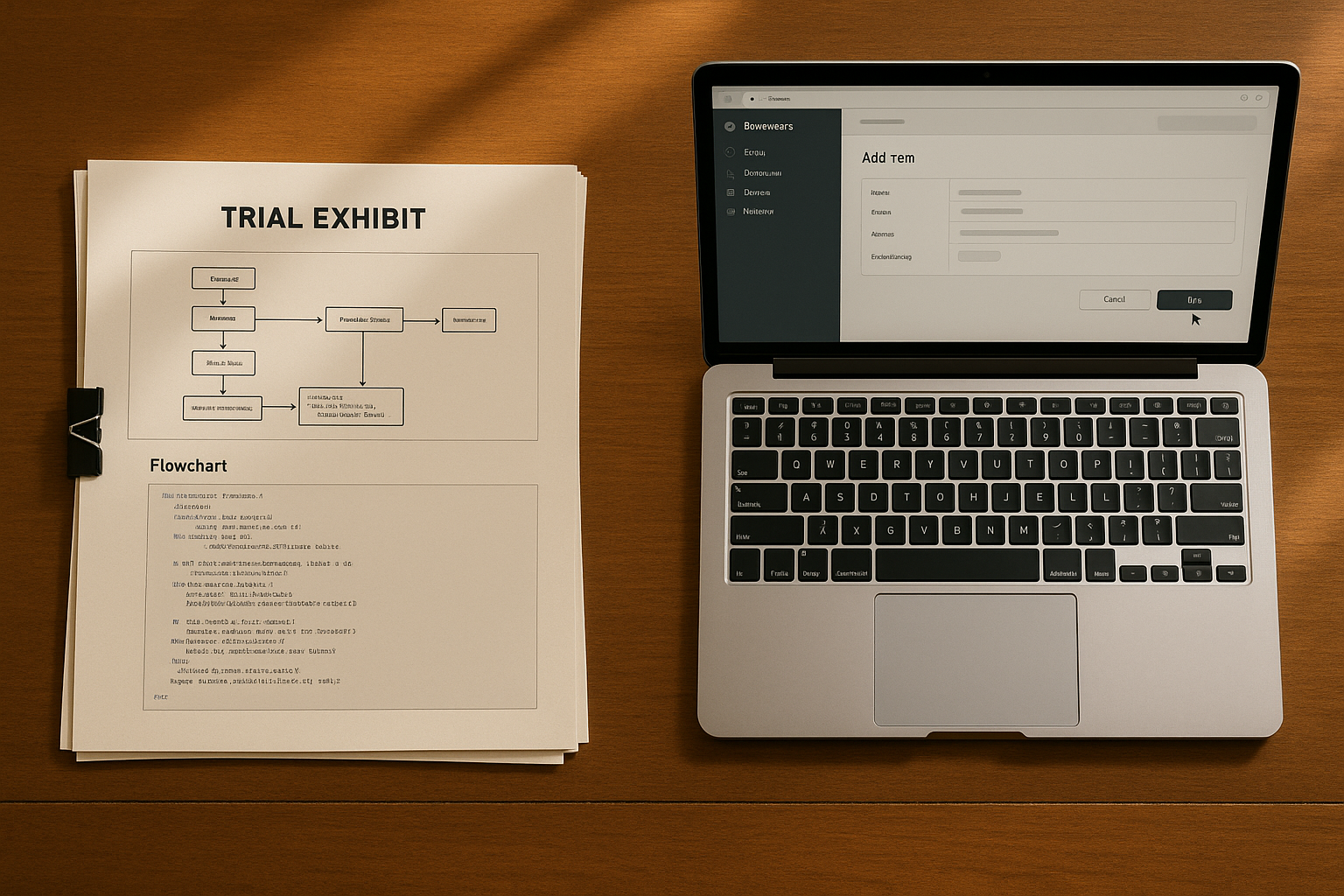
The central tension in this decision is straightforward: static exhibits offer control, predictability, and a stable record, while interactive software demonstrations offer immersion, immediacy, and the ability to show causation in real time. Neither format is universally superior. Juror comprehension directly influences damages awards and liability findings in patent and trade secret cases, and the format mismatch between the technical evidence and the audience’s cognitive processing can undermine even the strongest technical position. Selecting between static and interactive demonstratives is a strategic decision that demands pre-trial analysis, not a last-minute production call.
Key Takeaways for IP Litigation Firms
- The format of demonstrative evidence, whether static or interactive, should be determined by proceeding type, audience, budget, and risk tolerance, not by what is easiest to produce closest to trial.
- Static exhibits dominate Markman hearings and claim construction proceedings because federal judges value technical precision and a stable written record over real-time demonstration.
- Interactive software demonstrations carry significant logistical, authentication, and Daubert risks that require early mitigation planning, including pre-recorded video fallbacks and advance courthouse technology inspections.
- Opposing counsel can demand the source code of a custom interactive demo in discovery, raising confidentiality and work-product considerations that litigation teams must address before development begins.
- Understanding when to engage a software expert witness in patent litigation is foundational to this collaboration: early involvement between trial counsel, technical expert witnesses, and trial graphics consultants produces more cohesive demonstrative strategies and reduces costly revision cycles.
How Juries and Judges Process Static Flowcharts Versus Live Code Demonstrations
Cognitive Load and the Static Exhibit Advantage
Mock trial research and post-trial juror surveys consistently support the value of visual aids in complex technical cases. Approximately 65% of jurors report that visual aids significantly improved their understanding of complex technical evidence, according to surveys conducted by litigation consulting firms cited by the American Bar Association Litigation Section. Static exhibits, including annotated flowcharts, architecture diagrams, claim charts, and annotated screenshots, deliver a particular advantage during deliberations: jurors can return to them, study them at their own pace, and anchor their reasoning to a fixed visual reference. Cognitive load theory supports this dynamic. When jurors are asked to simultaneously watch a live software demonstration, listen to expert narration, and form technical judgments, the cognitive demand frequently exceeds the working memory capacity of non-technical fact finders.
The Federal Judicial Center’s Manual for Complex Litigation explicitly recognizes the challenge of presenting technical evidence to lay audiences and encourages courts and counsel to prioritize clarity and comprehension over technical completeness. Static exhibits align naturally with that guidance.
When Interactive Demonstrations Add Genuine Value
Interactive demonstrations earn their place when the infringing behavior or the patented functionality cannot be adequately conveyed in a still image. Showing how a recommendation algorithm responds dynamically to user input, or demonstrating that a specific sequence of API calls triggers a patented process, can be far more persuasive in real time than any annotated diagram. The risk, however, is juror skepticism. When a live demo appears rehearsed, selective, or suspiciously flawless, jurors sometimes interpret it as a magic trick rather than objective technical evidence. That perception can damage credibility more than the demo gains in persuasion.
Federal judges in bench trials respond differently. In Markman hearings and claim construction proceedings, judges value technical depth and precision. A carefully constructed static claim chart, with annotated source code excerpts cross-referenced to claim language, typically carries more weight with a technically sophisticated judge than a live demonstration of the same functionality.
Technical Failure and Courtroom Logistics Risks of Interactive Software Demonstrations
Documented Categories of Failure
The categories of technical failure that can derail an interactive software demonstration at trial are well documented in litigation support practice. Software crashes, dependency conflicts, operating system version mismatches, network connectivity requirements, and hardware incompatibility with courtroom AV systems represent the most common failure modes. Many federal courthouses operate with outdated AV infrastructure, restricted USB ports, and no public internet access, conditions that can render a demonstration environment inoperable on the morning of trial.
The “demo effect” phenomenon, the well-observed tendency for software to behave unexpectedly precisely when it matters most, carries serious reputational consequences in a courtroom setting. A failed or inconsistent interactive demo gives opposing counsel a powerful cross-examination tool. Counsel can challenge whether the expert truly understands the software’s behavior, whether the demonstration environment accurately represents the accused product, and whether the failure reveals a methodological flaw in the expert’s analysis.
Mitigation Strategies Litigation Teams Should Implement
Litigation teams that commit to interactive demonstrations should build the following protections into their pre-trial workflow:
- Conduct an advance courthouse technology inspection to identify AV system specifications, USB restrictions, and network availability.
- Prepare a pre-recorded video fallback that captures the intended demonstration behavior in a controlled environment.
- Configure a fully self-contained sandbox environment that requires no network connectivity or external dependencies.
- Retain dedicated IT support available on-site during the demonstration.
- Address chain of custody and authentication for the demonstration device itself, particularly when running software on counsel-controlled hardware rather than courtroom systems.
Judicial discretion also plays a role. Courts retain authority to limit or exclude interactive demonstrations that disrupt proceedings or consume disproportionate trial time, a risk that static exhibits do not carry.
Admissibility Standards and Foundation Requirements: Static Exhibits Versus Interactive Demonstratives in Software IP Litigation
Authentication Under the Federal Rules of Evidence
The Federal Rules of Evidence impose distinct authentication burdens depending on whether a demonstrative is static or interactive. Under FRE 901 and 902, any exhibit must be authenticated as what its proponent claims it to be. For static exhibits, including annotated screenshots, architecture diagrams, and printed source code excerpts, authentication typically requires expert testimony establishing the exhibit’s origin, the version of the software depicted, and the accuracy of any annotations. Chain of custody documentation and version control records are standard foundation elements.
Interactive demonstrations carry a heavier foundation burden. Under FRE 1001 through 1006, when a live demonstration purports to represent the accused or patented software at the relevant time, the proponent must establish that the demonstration environment is a true and accurate representation of that product as it existed during the alleged infringement period. This becomes particularly complex when the accused software has been updated or patched since the relevant date, a common situation in technology litigation.
Daubert Scrutiny and Motions in Limine
Daubert challenges and FRE 702 scrutiny apply to interactive demonstrations with particular force, and staying current on expert witness trends in software IP litigation helps litigation teams anticipate and counter these challenges effectively. Courts have examined whether a live demo reflects the expert’s reliable methodology or functions primarily as illustrative advocacy dressed up as technical analysis. According to the RAND Institute for Civil Justice, Daubert challenges succeed in excluding or limiting expert testimony in approximately 25 to 30% of cases where motions are filed, a significant risk that underscores the importance of methodologically grounded demonstratives.
Opposing counsel routinely file motions in limine targeting interactive demos on foundation grounds or under FRE 403, arguing that the risk of unfair prejudice or juror confusion substantially outweighs the probative value. Static exhibits, by contrast, are more readily pre-marked and stipulated to in pretrial orders, reducing the burden on trial counsel and the risk of last-minute exclusion.
On the discovery question that many litigation teams raise: yes, opposing counsel can demand the source code of a custom interactive demonstration during discovery if it was developed specifically for the litigation. That demand creates confidentiality, work-product, and cost considerations that should be evaluated before development begins.
Cost, Production Timeline, and Resource Comparison Across Pre-Trial and Trial Phases
Static Exhibit Production Economics
Static exhibit production involves graphic design fees, expert review cycles, large-format printing, and iteration costs during claim construction. These costs are predictable and manageable. Static exhibits can typically be finalized within two to four weeks following a claim construction order, and they are easily revised after deposition testimony or adverse claim construction rulings without triggering a full redevelopment cycle.
Interactive Demo Production Economics
Interactive demonstration production involves software development or sandboxing fees, software expert witness time for demo scripting, quality assurance testing, and contingency planning. Development timelines typically run six to twelve weeks, and revisions require re-development cycles rather than simple graphic updates. Hidden costs include expert travel with specialized hardware, courtroom setup time, and the potential obligation to produce the demo’s source code in discovery.
Budget allocation should reflect case scale. Smaller cases with focused claim disputes are generally better served by well-constructed static exhibits. Larger, high-stakes cases with multimillion-dollar damages claims — such as the high-profile breach of contract verdict resulting in a $20M jury award — may justify the investment in a tightly controlled interactive demonstration, provided the logistical and admissibility risks are actively managed.
The vendor landscape matters here as well. Trial graphics consultants specialize in static exhibit design and narrative visualization, while software litigation support firms bring the engineering expertise needed to build defensible interactive environments. The two disciplines rarely overlap, and litigation teams should engage both categories of vendor early in the case lifecycle.
Matching the Right Demonstrative Format to the Right Proceeding
Markman Hearings and Claim Construction
In claim construction proceedings before the Court of Appeals for the Federal Circuit and district courts, annotated static claim charts and architecture diagrams dominate for good reason. Judges conducting Markman hearings are focused on the intrinsic record, claim language, the specification, and prosecution history. Static side-by-side comparisons of claim language against accused functionality give judges a stable reference document they can annotate and return to during deliberation on claim scope. A limited interactive demonstration of a single disputed feature may add value in narrow circumstances, but it should supplement rather than replace the written exhibit record.
Jury Trial Scenarios
Opening statements benefit from large-format static storyboards that establish the technical narrative before expert testimony begins. On direct examination, a brief, tightly controlled interactive demonstration of a specific infringing behavior can be more persuasive than any static alternative, particularly when the behavior involves dynamic software responses that are difficult to represent in a still image. On cross-examination, static exhibits protect the expert by eliminating the risk of unexpected software behavior that opposing counsel can exploit.
Specialized Forums: PTAB and ITC Proceedings
PTAB proceedings are conducted before technically sophisticated administrative patent judges who are comfortable with detailed static exhibits, claim charts, and annotated prior art references. Interactive demonstrations are rare in this forum and generally unnecessary. ITC Section 337 investigations blend elements of district court practice with administrative procedure, and demonstrative format preferences tend to follow district court norms, with static exhibits forming the primary record and interactive elements used selectively.In trade secret misappropriation cases, where trade secret litigation filings increased by over 30% in the five years following the Defend Trade Secrets Act of 2016 according to Lex Machina, interactive demonstrations showing how stolen code functions in the defendant’s product can be highly persuasive. Static side-by-side source code comparisons, however, remain the foundational exhibit type because they create a precise, line-by-line record that supports both liability arguments and damages quantification.
Build a Demonstrative Evidence Strategy That Holds Up Under Pressure
The decision framework for demonstrative evidence in software IP litigation reduces to five factors: the audience (judge, jury, or administrative panel), the proceeding type (Markman, jury trial, PTAB, or ITC), the technical complexity of the disputed functionality, the available budget and timeline, and the litigation team’s risk tolerance for logistical and admissibility challenges.
The most durable approach for high-stakes cases is a hybrid strategy: static exhibits serve as the primary record throughout the case, providing a stable foundation for claim construction, expert direct examination, and jury deliberations. Interactive demonstrations are reserved for one or two pivotal moments where real-time causation or dynamic behavior is essential to the liability or damages narrative. That discipline, limiting interactive elements to moments of maximum persuasive impact, reduces logistical risk while preserving the format’s genuine advantages.
Early collaboration between litigation counsel, technical expert witnesses, and trial graphics consultants is not optional in complex software IP cases. Demonstrative strategy built late in the case lifecycle, after depositions are complete and claim construction is final, costs more, revises poorly, and frequently misaligns with the expert’s actual testimony.
IP litigation firms developing demonstrative evidence strategy for software patent, trade secret, or technology disputes can schedule a 20-minute consultation with a qualified software expert witness to align technical analysis with demonstrative planning from the earliest stages of case development. Expert support encompassing source code review, software architecture analysis, and software expert witness preparation for demonstrative evidence in software IP litigation is available across district court, PTAB, and ITC matters.
Written by
Related Insights

Discuss your Case
- info@sidespingroup.com
- (800) 510-6844
- Monday – Friday
- 8am – 6pm PT
- 11am – 9pm ET
Lead Expert